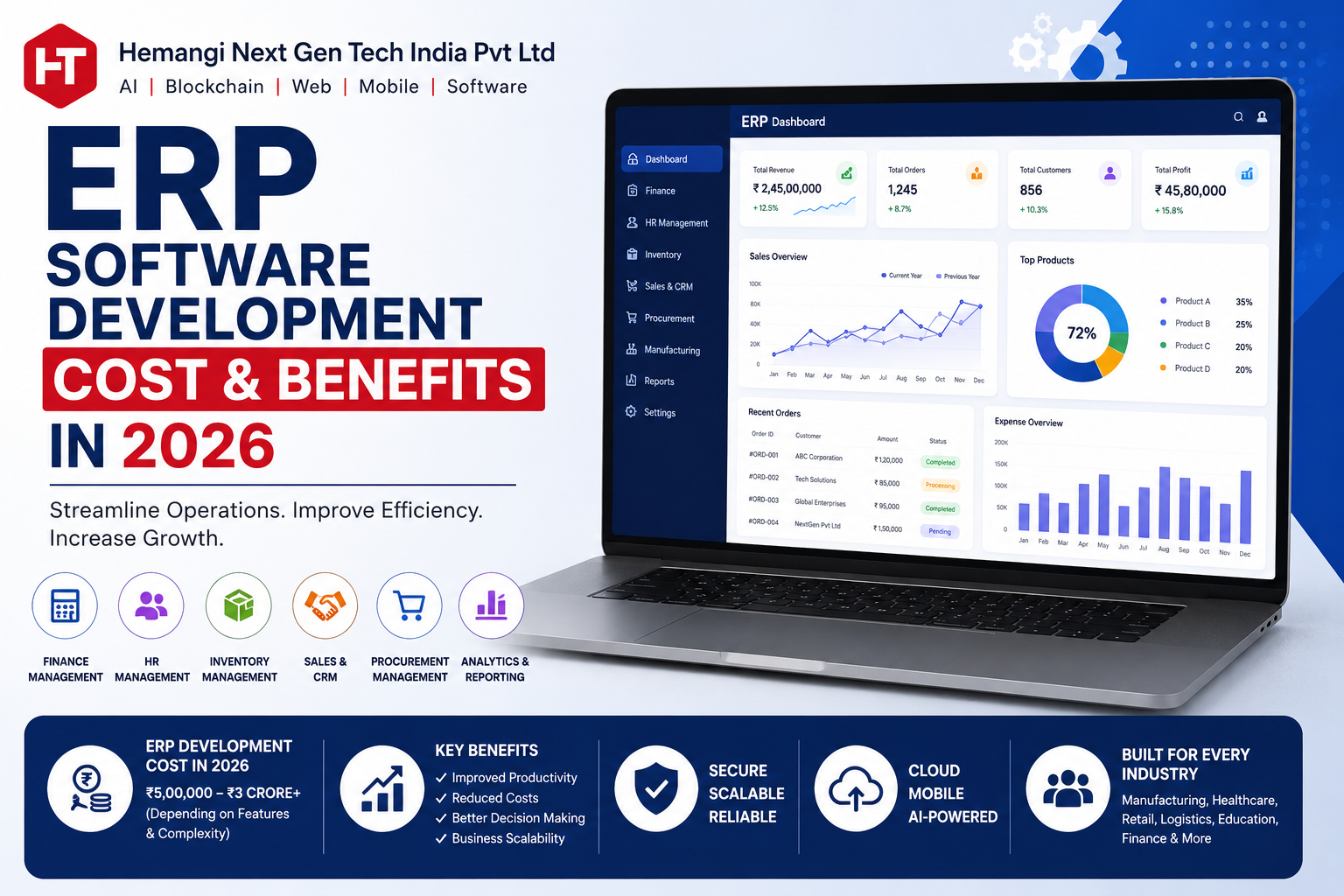
ERP Software Development Cost and Benefits in 2026 | Complete Guide
Introduction
As businesses continue to digitize operations in 2026, Enterprise Resource Planning (ERP) software has become one of the most valuable investments for organizations seeking efficiency, scalability, and data-driven decision-making. Modern ERP systems integrate various business functions such as finance, inventory management, sales, human resources, procurement, manufacturing, customer management, and reporting into a single centralized platform.
Whether you're a startup, SME, manufacturing company, healthcare organization, logistics provider, or enterprise business, implementing a custom ERP solution can significantly improve operational efficiency and business growth.
In this guide, we'll explore ERP software development costs in 2026, key features, business benefits, factors affecting pricing, and how to choose the right ERP development company.
What is ERP Software?
ERP (Enterprise Resource Planning) software is a centralized business management system that connects different departments and processes into one integrated platform.
Instead of using separate software for accounting, inventory, HR, procurement, sales, and operations, ERP consolidates everything into a single ecosystem.
This enables organizations to:
-
Improve productivity
-
Automate workflows
-
Reduce operational costs
-
Eliminate data silos
-
Improve decision making
-
Increase transparency
Core Modules of ERP Software
A modern ERP system may include:
Financial Management
-
Accounting
-
General Ledger
-
Accounts Payable
-
Accounts Receivable
-
Budget Management
Human Resource Management
-
Employee Records
-
Attendance Tracking
-
Payroll Management
-
Recruitment Management
-
Performance Monitoring
Inventory Management
-
Stock Tracking
-
Warehouse Management
-
Barcode Integration
-
Purchase Orders
-
Inventory Forecasting
Sales & CRM
-
Lead Management
-
Customer Database
-
Sales Pipeline
-
Quotations
-
Order Processing
Procurement Management
-
Vendor Management
-
Purchase Requests
-
Procurement Tracking
-
Supplier Evaluation
Manufacturing Management
-
Production Planning
-
Bill of Materials
-
Production Tracking
-
Quality Control
Analytics & Reporting
-
Real-Time Dashboards
-
Business Intelligence
-
KPI Monitoring
-
Custom Reports
ERP Software Development Cost in 2026
ERP software development costs vary significantly depending on complexity, features, integrations, user base, and deployment architecture.
Basic ERP Software
Suitable for startups and small businesses.
Features:
-
User Management
-
Inventory Management
-
Sales Management
-
Basic Reporting
Estimated Cost:
₹5,00,000 – ₹15,00,000
($6,000 – $18,000)
Mid-Level ERP Software
Suitable for growing businesses and SMEs.
Features:
-
Multiple Modules
-
HR Management
-
CRM Integration
-
Procurement Management
-
Advanced Reporting
Estimated Cost:
₹15,00,000 – ₹50,00,000
($18,000 – $60,000)
Enterprise ERP Software
Suitable for large organizations.
Features:
-
Multi-Location Operations
-
Advanced Automation
-
AI Integration
-
Business Intelligence
-
Workflow Management
-
ERP Mobile Applications
Estimated Cost:
₹50,00,000 – ₹3 Crore+
($60,000 – $350,000+)
Factors Affecting ERP Development Cost
Number of Modules
More modules increase development complexity and cost.
Examples:
-
Finance
-
HR
-
CRM
-
Inventory
-
Manufacturing
-
Procurement
Customization Requirements
Highly customized ERP platforms require:
-
Custom Workflows
-
Business Logic Development
-
Role-Based Access Control
-
Department-Specific Features
This significantly impacts development budgets.
Technology Stack
Modern ERP platforms often use:
Frontend
-
React.js
-
Angular
-
Next.js
Backend
-
Node.js
-
.NET
-
Java
-
Python
Database
-
PostgreSQL
-
MySQL
-
MongoDB
Mobile App Integration
Organizations increasingly require:
-
Android ERP Apps
-
iOS ERP Apps
-
Employee Self-Service Apps
Mobile development increases overall project cost.
Third-Party Integrations
ERP systems frequently integrate with:
-
Payment Gateways
-
CRM Platforms
-
Accounting Systems
-
Banking APIs
-
E-Commerce Platforms
-
IoT Devices
Additional integrations increase implementation effort.
Benefits of ERP Software
Improved Productivity
ERP automates repetitive tasks, reducing manual work and improving employee efficiency.
Centralized Data Management
All business information is stored in one location, providing a single source of truth.
Better Decision Making
Real-time reporting and analytics help management make informed decisions faster.
Reduced Operational Costs
Automation reduces administrative overhead and operational inefficiencies.
Enhanced Customer Experience
Integrated CRM and customer management modules improve customer service and retention.
Scalability
ERP systems grow alongside your business and support expansion without major disruptions.
Better Compliance
ERP platforms help businesses maintain compliance through audit logs, reporting tools, and data security controls.
Industries Using ERP Software
ERP systems are widely adopted across industries including:
Manufacturing
Production planning and inventory management.
Healthcare
Patient administration and resource management.
Retail & E-Commerce
Inventory tracking and order management.
Logistics & Transportation
Fleet management and shipment tracking.
Education
Student and administrative management.
Real Estate
Property and project management.
Construction
Project planning and procurement tracking.
Finance
Operational and compliance management.
ERP Trends in 2026
Modern ERP solutions are rapidly evolving with:
Artificial Intelligence
-
Predictive Analytics
-
Demand Forecasting
-
Intelligent Automation
Cloud ERP
-
Reduced Infrastructure Costs
-
Remote Accessibility
-
Better Scalability
Mobile ERP
-
Anywhere Access
-
Real-Time Updates
-
Workforce Mobility
IoT Integration
-
Smart Manufacturing
-
Asset Tracking
-
Predictive Maintenance
Advanced Business Intelligence
-
Real-Time Insights
-
Interactive Dashboards
-
Data Visualization
How to Choose an ERP Development Company
When selecting an ERP software development partner, evaluate:
-
ERP Development Experience
-
Industry Expertise
-
Technology Capabilities
-
Security Standards
-
Customization Expertise
-
Support & Maintenance Services
-
Client Portfolio
A reliable ERP development company should understand your business processes and build solutions tailored to your operational needs.
Why Choose Hemangi Next Gen Tech India Pvt Ltd for ERP Development?
Hemangi Next Gen Tech India Pvt Ltd specializes in developing scalable ERP software solutions for startups, SMEs, enterprises, healthcare organizations, logistics providers, manufacturing companies, and fintech businesses.
Our ERP development services include:
-
Custom ERP Development
-
Cloud ERP Solutions
-
ERP Modernization
-
Mobile ERP Applications
-
AI-Powered ERP Systems
-
ERP Integration Services
-
Ongoing Maintenance & Support
We build secure, scalable, and future-ready ERP platforms that streamline business operations and drive growth.
Conclusion
ERP software has become a critical digital transformation tool for modern businesses. While ERP development costs vary based on complexity and functionality, the long-term benefits significantly outweigh the investment.
From process automation and centralized data management to improved decision-making and business scalability, ERP systems provide organizations with the technological foundation needed to compete effectively in 2026 and beyond.
Businesses planning digital transformation initiatives should consider custom ERP software development as a strategic investment that delivers measurable operational and financial returns.