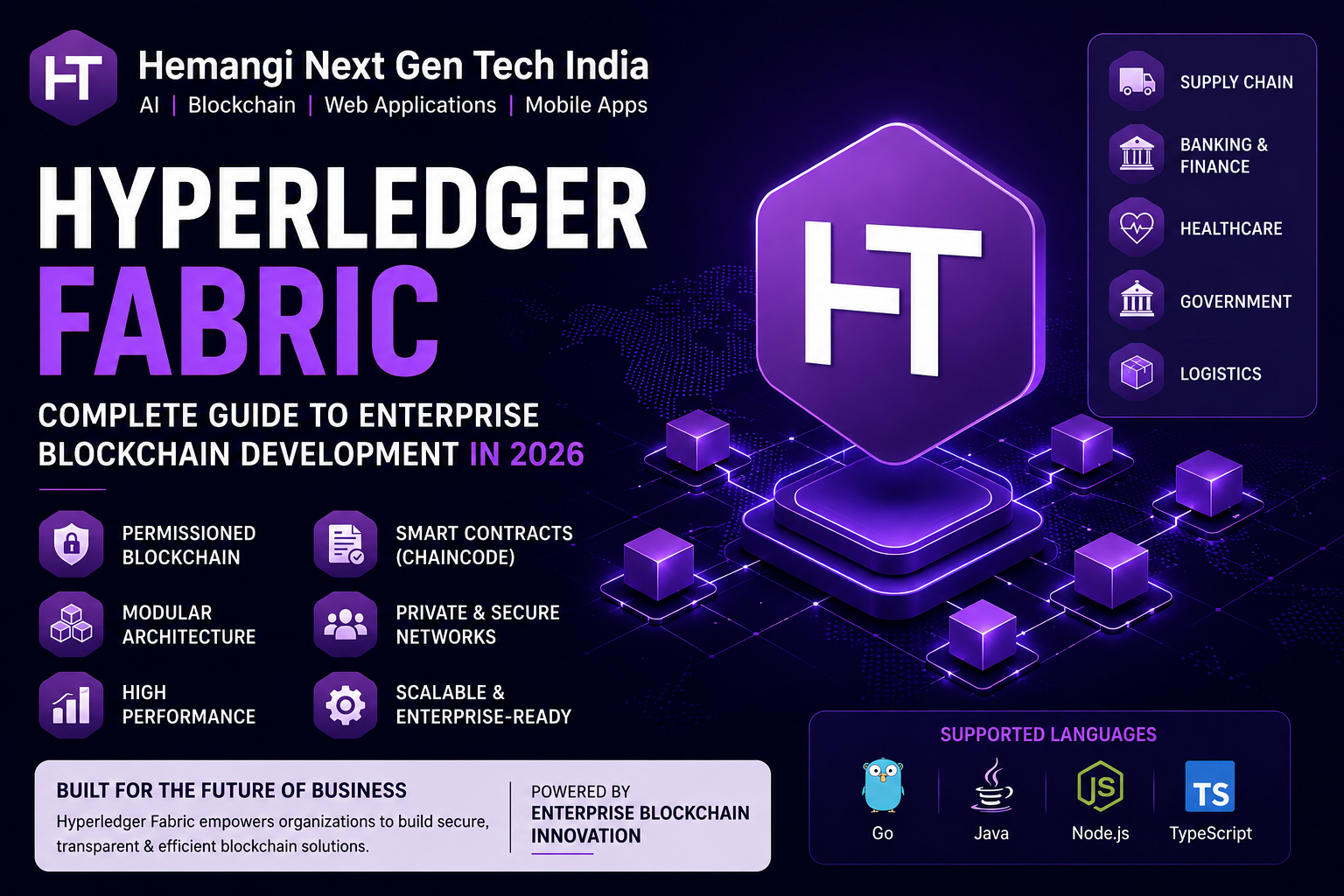
Hyperledger Fabric: Complete Guide to Enterprise Blockchain Development in 2026
Blockchain technology has evolved far beyond cryptocurrencies. Today, businesses across industries are adopting blockchain to improve transparency, security, efficiency, and trust. Among the various blockchain frameworks available, Hyperledger Fabric has emerged as one of the most powerful and widely adopted enterprise blockchain platforms.
Organizations worldwide use Hyperledger Fabric to build secure, scalable, and permissioned blockchain networks that support real-world business processes. In this guide, we'll explore what Hyperledger Fabric is, how it works, its architecture, benefits, use cases, and why it remains a leading choice for enterprise blockchain development in 2026.
What is Hyperledger Fabric?
Hyperledger Fabric is an open-source enterprise blockchain framework developed under the Hyperledger project hosted by the Linux Foundation.
Unlike public blockchains such as Bitcoin and Ethereum, Hyperledger Fabric is designed specifically for business applications that require privacy, scalability, and permissioned access.
The platform enables organizations to create blockchain networks where participants are known and verified, making it ideal for enterprise use cases.
Key characteristics include:
- Permissioned Blockchain Network
- High Scalability
- Enhanced Privacy
- Smart Contract Support
- Modular Architecture
- Enterprise Security
Why Hyperledger Fabric is Different from Public Blockchains
Traditional public blockchains allow anyone to participate anonymously.
Hyperledger Fabric follows a different approach by providing:
Permissioned Access
Every participant is authenticated before joining the network.
Data Privacy
Organizations can control who can view specific transactions.
High Performance
Fabric achieves significantly higher transaction throughput compared to many public blockchain networks.
Regulatory Compliance
Permissioned networks help organizations meet industry and government regulations.
Hyperledger Fabric Architecture
Hyperledger Fabric consists of several core components that work together to create a secure blockchain network.
Peers
Peers are nodes that maintain the ledger and execute smart contracts.
Functions include:
- Ledger Storage
- Transaction Validation
- Smart Contract Execution
Ordering Service
The ordering service is responsible for:
- Transaction Ordering
- Block Creation
- Network Consensus
This component ensures all participants receive transactions in the same order.
Membership Service Provider (MSP)
The MSP manages identities within the blockchain network.
Responsibilities include:
- User Authentication
- Access Control
- Certificate Management
Channels
Channels allow private communication between selected network participants.
Benefits include:
- Enhanced Privacy
- Confidential Transactions
- Controlled Data Sharing
Smart Contracts in Hyperledger Fabric
In Hyperledger Fabric, smart contracts are called Chaincode.
Chaincode contains business rules and logic that automatically execute when predefined conditions are met.
Examples include:
- Supply Chain Tracking
- Insurance Claims Processing
- Trade Finance Automation
- Asset Management
Supported programming languages include:
- Go
- Java
- JavaScript
- TypeScript
Key Features of Hyperledger Fabric
Modular Architecture
Organizations can customize components according to business requirements.
Permissioned Network
Only verified participants can access the blockchain.
Private Transactions
Sensitive business data can remain visible only to authorized parties.
Scalability
Fabric supports enterprise-grade transaction volumes.
Security
Advanced cryptographic mechanisms protect network integrity.
Smart Contract Support
Businesses can automate complex workflows and agreements.
Benefits of Hyperledger Fabric for Businesses
Improved Security
Fabric uses identity management and cryptographic security to protect transactions and data.
Enhanced Transparency
All authorized participants have access to a shared source of truth.
Reduced Costs
Automation and process optimization reduce operational expenses.
Faster Transactions
Fabric supports high transaction throughput and low latency.
Better Compliance
Permissioned access helps organizations comply with industry regulations.
Hyperledger Fabric Use Cases
Supply Chain Management
Businesses can track products from manufacturing to delivery.
Benefits include:
- Product Traceability
- Fraud Prevention
- Real-Time Visibility
Healthcare
Healthcare providers use Fabric to securely share patient records.
Advantages include:
- Data Security
- Controlled Access
- Regulatory Compliance
Banking and Finance
Financial institutions use Hyperledger Fabric for:
- Trade Finance
- Cross-Border Payments
- Asset Tokenization
- Digital Identity Management
Government Solutions
Governments use blockchain for:
- Document Verification
- Land Registry Systems
- Digital Identity Platforms
Logistics
Fabric helps logistics companies improve shipment tracking and operational efficiency.
Hyperledger Fabric vs Ethereum
Hyperledger Fabric
- Permissioned Network
- Enterprise Focused
- High Privacy
- High Scalability
- Controlled Access
Ethereum
- Public Blockchain
- Open Participation
- Greater Transparency
- Decentralized Ecosystem
- Public Smart Contracts
Businesses typically choose Hyperledger Fabric when privacy and compliance are essential requirements.
Industries Using Hyperledger Fabric
Hyperledger Fabric is widely adopted across industries such as:
- Banking
- Healthcare
- Insurance
- Supply Chain
- Manufacturing
- Logistics
- Government
- Real Estate
- Education
- Retail
Its flexibility makes it suitable for both startups and large enterprises.
Hyperledger Fabric Development Process
A typical Hyperledger Fabric development project includes:
Requirement Analysis
Understanding business goals and blockchain requirements.
Network Architecture Design
Designing nodes, channels, and governance models.
Smart Contract Development
Creating chaincode to automate business processes.
Integration
Connecting blockchain systems with existing enterprise software.
Testing
Performing security, performance, and functionality testing.
Deployment
Launching the blockchain network in production environments.
Why Businesses Choose Hyperledger Fabric in 2026
As enterprise blockchain adoption continues to grow, organizations require solutions that provide security, privacy, scalability, and regulatory compliance.
Hyperledger Fabric delivers all these capabilities while supporting complex business workflows and integrations.
Its enterprise-focused architecture makes it one of the most trusted blockchain frameworks for modern digital transformation initiatives.
Conclusion
Hyperledger Fabric has established itself as a leading enterprise blockchain platform for organizations seeking secure and scalable blockchain solutions. Its permissioned architecture, smart contract capabilities, privacy controls, and modular design make it ideal for real-world business applications.
From supply chain management and healthcare to finance and government services, Hyperledger Fabric continues to drive innovation across industries. Businesses investing in blockchain technology can leverage Hyperledger Fabric to build transparent, efficient, and future-ready digital ecosystems.
FAQ Section
Q1. What is Hyperledger Fabric?
Hyperledger Fabric is an open-source enterprise blockchain framework designed for permissioned blockchain networks and business applications.
Q2. Is Hyperledger Fabric public or private?
Hyperledger Fabric is primarily a permissioned blockchain platform where participants are verified before joining the network.
Q3. What programming languages are used in Hyperledger Fabric?
Developers can create chaincode using Go, Java, JavaScript, and TypeScript.
Q4. What industries use Hyperledger Fabric?
Industries such as banking, healthcare, supply chain, logistics, insurance, manufacturing, and government use Hyperledger Fabric.
Q5. Why is Hyperledger Fabric popular for enterprise blockchain development?
It offers security, privacy, scalability, modular architecture, and compliance capabilities that are essential for enterprise applications.