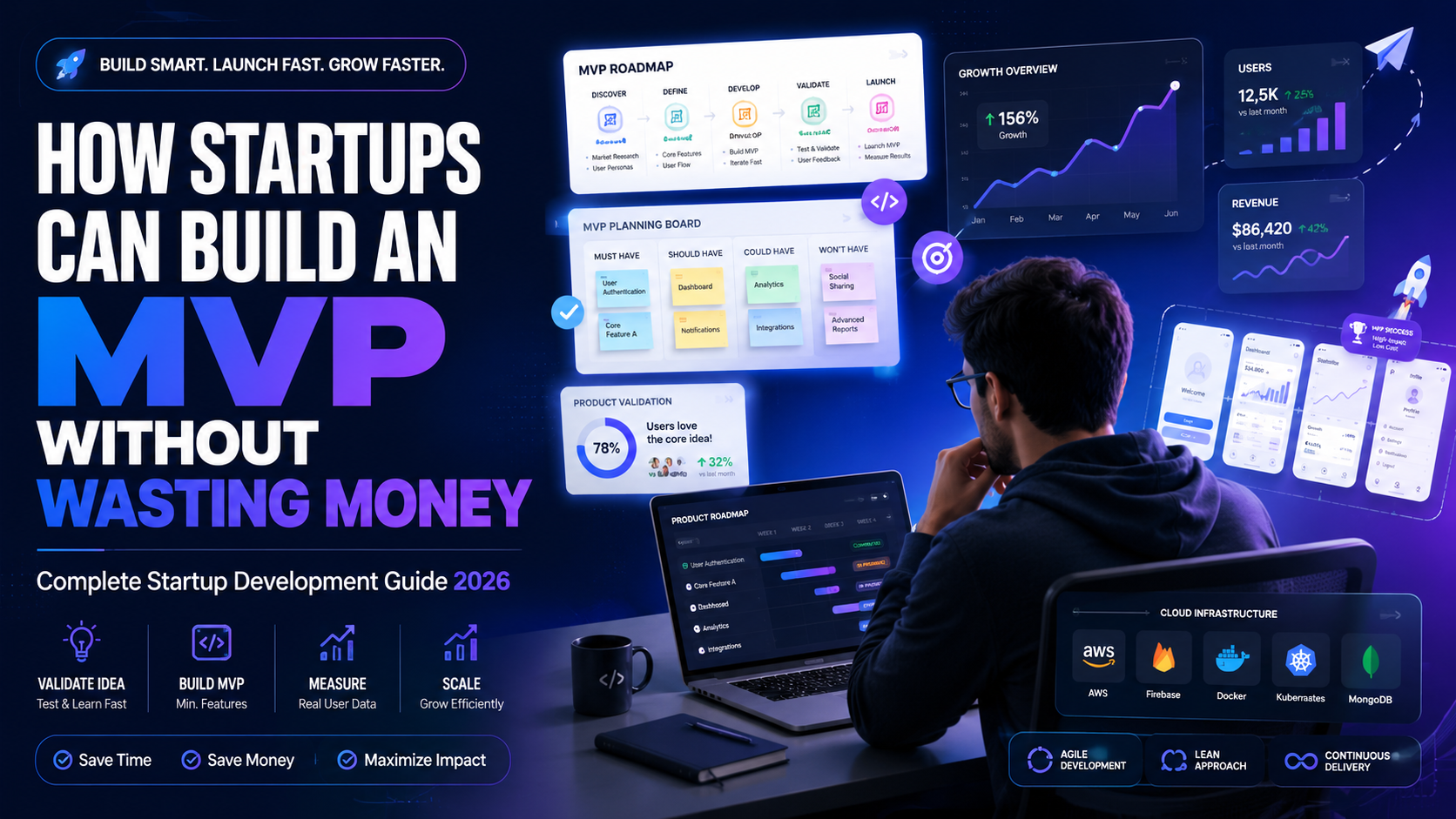
How Startups Can Build an MVP Without Wasting Money: The Ultimate Startup Guide for 2026
Every successful startup begins with an idea. However, having a great idea is only the first step. The real challenge lies in transforming that idea into a product people actually want to use. Unfortunately, many startup founders make the mistake of investing huge amounts of money into building a complete product before validating whether there is genuine market demand.
According to industry reports, nearly 90% of startups fail, and one of the biggest reasons is spending too much money building products that customers don't need. This is where MVP development becomes one of the most important strategies for startup success.
An MVP, or Minimum Viable Product, allows startups to launch faster, validate assumptions, reduce risk, and save significant development costs. Instead of spending millions building every possible feature, founders can focus on creating a simplified version of their product and testing it with real users.
In this comprehensive guide, we'll explore how startups can build an MVP without wasting money, avoid common mistakes, choose the right development strategy, and maximize their chances of success.
What Is an MVP?
An MVP (Minimum Viable Product) is the most basic version of a product that contains only the essential features required to solve a specific problem for users.
The purpose of an MVP is not to create a perfect product. Instead, it helps businesses validate their assumptions before making larger investments.
A successful MVP allows startups to:
- Test market demand
- Gather user feedback
- Attract investors
- Reduce development risks
- Improve product-market fit
- Save development costs
- Launch faster
The MVP approach was popularized by Eric Ries in his book "The Lean Startup" and has since become a standard practice in startup software development.
Why Most Startups Waste Money During Product Development
Many founders believe that building more features automatically leads to a better product. In reality, excessive development often creates unnecessary complexity and higher costs.
Common reasons startups overspend include:
1. Building Too Many Features
Founders often try to solve every problem at once. Instead of focusing on a core solution, they add features that users may never use.
2. Skipping Market Validation
Many startups invest heavily in development before confirming whether customers actually want the product.
3. Hiring Large Teams Too Early
A startup with limited funding doesn't need a large engineering department on day one.
4. Constantly Changing Requirements
Frequent scope changes increase development costs and delay product launches.
5. Choosing Expensive Technology Stacks
Using overly complex technologies for simple products can dramatically increase costs.
Why MVP Development Is Important for Startups
MVP development allows startups to operate efficiently while minimizing risk.
Benefits include:
Faster Market Entry
Launching early gives startups a competitive advantage.
Reduced Financial Risk
Instead of investing heavily upfront, founders can validate demand with minimal investment.
Better Product Decisions
Real customer feedback is more valuable than assumptions.
Improved Investor Confidence
Investors are more likely to fund startups that demonstrate market validation.
Higher Probability of Success
Products built using user feedback have a better chance of achieving product-market fit.
Step 1: Validate Your Business Idea Before Building Anything
Before hiring developers or creating designs, startups should validate their ideas.
Ask these questions:
- What problem does the product solve?
- Who experiences this problem?
- How severe is the problem?
- Are customers willing to pay for a solution?
- What alternatives currently exist?
Validation Methods
Customer Interviews
Speak directly with potential customers.
Surveys
Use Google Forms and Typeform to collect insights.
Landing Pages
Create a simple website explaining your idea.
Social Media Testing
Run targeted campaigns to measure interest.
Competitor Analysis
Study existing products and identify gaps.
Validation can save months of development and thousands of dollars.
Step 2: Define Your Core Value Proposition
Many startups fail because they don't clearly understand the primary value their product offers.
Ask yourself:
"What is the one problem our product solves better than anyone else?"
Your MVP should focus exclusively on that answer.
Examples:
Uber
Core value: Book a ride quickly.
Airbnb
Core value: Rent accommodations from local hosts.
Dropbox
Core value: Sync files across devices.
The simpler the value proposition, the easier and cheaper the MVP becomes.
Step 3: Prioritize Features Using the MoSCoW Method
Feature prioritization prevents unnecessary spending.
Divide features into:
Must Have
Essential features required for launch.
Should Have
Useful but not critical.
Could Have
Nice additions for future versions.
Won't Have
Features intentionally postponed.
For example, if building a food delivery app:
Must Have:
- User registration
- Restaurant listing
- Order placement
- Payment processing
Should Have:
- Reviews
- Ratings
Could Have:
- Loyalty programs
Won't Have:
- AI recommendations
This approach significantly reduces MVP development costs.
Step 4: Choose the Right Development Approach
No-Code Development
Ideal for:
- Early validation
- Low budgets
- Simple products
Popular platforms:
- Bubble
- Webflow
- Glide
Low-Code Development
Provides more flexibility than no-code solutions.
Custom Development
Best for scalable and complex products.
Most serious startups eventually move toward custom software development.
Step 5: Select a Cost-Effective Technology Stack
Choosing the right technologies can reduce costs and accelerate development.
Recommended MVP Stack:
Frontend
- React.js
- Next.js
Backend
- Node.js
- Laravel
Mobile
- Flutter
- React Native
Database
- PostgreSQL
- MySQL
Cloud Infrastructure
- AWS
- Google Cloud
- Microsoft Azure
These technologies offer excellent scalability and strong developer communities.
Step 6: Consider Cross-Platform App Development
Building separate Android and iOS applications can double development costs.
Cross-platform frameworks like Flutter allow startups to maintain a single codebase.
Benefits include:
- Lower costs
- Faster development
- Easier maintenance
- Consistent user experience
Many startups save 30–50% using Flutter for MVP development.
Step 7: Outsource Development Strategically
Hiring a software development company can be more cost-effective than building an in-house team.
Advantages include:
- Access to experienced developers
- Faster project completion
- Reduced operational expenses
- Scalable resources
Countries like India have become global hubs for startup software development due to their strong technical talent and cost efficiency.
Step 8: Focus on User Experience, Not Fancy Design
Many startups waste money on elaborate UI designs before validating their concept.
Instead:
- Keep designs simple
- Prioritize usability
- Ensure easy navigation
- Optimize user onboarding
A clean, functional interface is often sufficient for MVP success.
Step 9: Launch as Quickly as Possible
Perfection delays learning.
The purpose of an MVP is to collect feedback.
Launch when:
- Core functionality works
- Major bugs are fixed
- Users can complete primary tasks
Early feedback often reveals issues that internal teams overlook.
Step 10: Measure Everything
Track key metrics such as:
- User acquisition
- Retention rate
- Session duration
- Customer feedback
- Conversion rate
- Revenue
Analytics tools:
- Google Analytics
- Mixpanel
- Hotjar
- Firebase Analytics
Data-driven decisions help optimize future development spending.
MVP Development Cost Breakdown
Basic MVP
Features:
- Login
- Dashboard
- Basic functionality
Cost:
₹1,50,000 – ₹5,00,000
Medium Complexity MVP
Features:
- Payments
- APIs
- Admin Panel
Cost:
₹5,00,000 – ₹15,00,000
Advanced MVP
Features:
- AI Integration
- Real-Time Features
- Advanced Security
Cost:
₹15,00,000 – ₹50,00,000+
Common MVP Development Mistakes
Building Too Many Features
Keep the first version lean.
Ignoring Customer Feedback
Users should guide product evolution.
Hiring Too Quickly
Grow the team only when necessary.
Overengineering
Build for today's needs, not hypothetical future requirements.
Delaying Launch
Every month of delay increases costs and reduces learning opportunities.
Real Examples of Successful MVPs
Airbnb
Started with a simple website offering air mattresses for rent.
Initially available only to Harvard students.
Uber
Launched with a basic ride-booking feature.
Dropbox
Validated demand using a simple demonstration video.
These companies focused on solving one problem before expanding.
Conclusion
Building an MVP is one of the smartest investments a startup can make. Instead of spending months and large amounts of capital building a fully featured product, startups should focus on validating their ideas quickly and efficiently.
By prioritizing core features, choosing the right technology stack, outsourcing strategically, and continuously learning from users, startups can dramatically reduce costs while increasing their chances of long-term success.
The goal isn't to build the perfect product. The goal is to build the right product.